

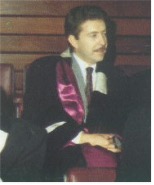
Andrea Rugiadini (May 29, 1943 – November 27, 2022) was first and foremost a Professor with a capital P, having made service to students and their personal as well as intellectual development a cornerstone of his work. For the discipline of Organization in Italy, he was a pioneer and founding father. Initially becoming a professor of Business Economics (University of Venice, 1972-1980), he was encouraged by Carlo Masini, a far-sighted dean of that discipline, to focus on business organization, which was absent from the landscape of business disciplines in Italy at the time. This path led him to become the principal architect of the founding of the Business Organization disciplinary group. He intuited and invested in the development of research and internationalization before others, encouraging and enabling young scholars to orient themselves in that direction, including through participation (then unusual in business disciplines) in doctoral programs. In 1979, he founded the Research Center on Business Organization (CRORA), promoting not only commissioned research, as was traditional in those years, but also empirical knowledge research projects such as the Organizational Observatory on Italian companies. He collaborated in the founding and directed for more than a decade, from the early 1970s, the journal ‘Sviluppo & Organizzazione’, contributing to making it the reference point it remains today in the editorial landscape of organization journals. Catalyzed by all these initiatives, as well as by Rugiadini’s attractive and argumentative capacity, a cohesive group of faculty and researchers formed and expanded around him for two decades, engaging daily in discussions on the didactic and scientific development of a discipline that was in its infancy, and later disseminated that legacy to many Italian universities; also through collective discussion of the first Italian textbook on Organization (Rugiadini, ‘Organizzazione d’impresa’ 1979).

In the 1980s, a period of great proliferation of new ‘perspectives’ in organization, mostly with sociological roots, he understood the importance of the emerging organizational economics, particularly transaction cost economics, destined to win a Nobel Prize in 2010. Evidence of this is the important anthology ‘Organizzazione e Mercato’ (1985), edited with colleague Raoul Nacamulli, on which many business organization scholars, as well as students, were trained. The Organization course he directed remains unique, capable of engaging something like a thousand students in a portfolio of parallel and semi-autonomous activities including lectures, simulations and behavioral experiments, theory seminars, and case discussions.
Not only a Professor, therefore, but a radical Thinker in every sense, for his innovative capacity, independence of judgment, and liberal spirit.
All those who knew Andrea, directly or indirectly, are invited to share brief testimonies and memories of the many ways he contributed to our individual and collective growth by participating in theCall for testimonies published on the ProspettiveinOrganizzazione website
